

If you live in Delhi, Mumbai, or Bengaluru, you already know the drill. AQI crosses 150 and the windows go shut. Air purifier on. You have done everything right, more or less.
But here is the thing nobody talks about. Sealed rooms have their own problem. It is not dramatic. There is no alarm, no visible smog. It is just CO2 quietly building up from 400 ppm to 1200, sometimes higher, while you sit at your desk wondering why you feel foggy after lunch. At those levels, cognitive performance measurably drops. It is not in your head. It is literally in your air.
Most air purifiers stop there. Filter the bad stuff, call it done. The oxygen-to-CO2 ratio stays exactly where it was.
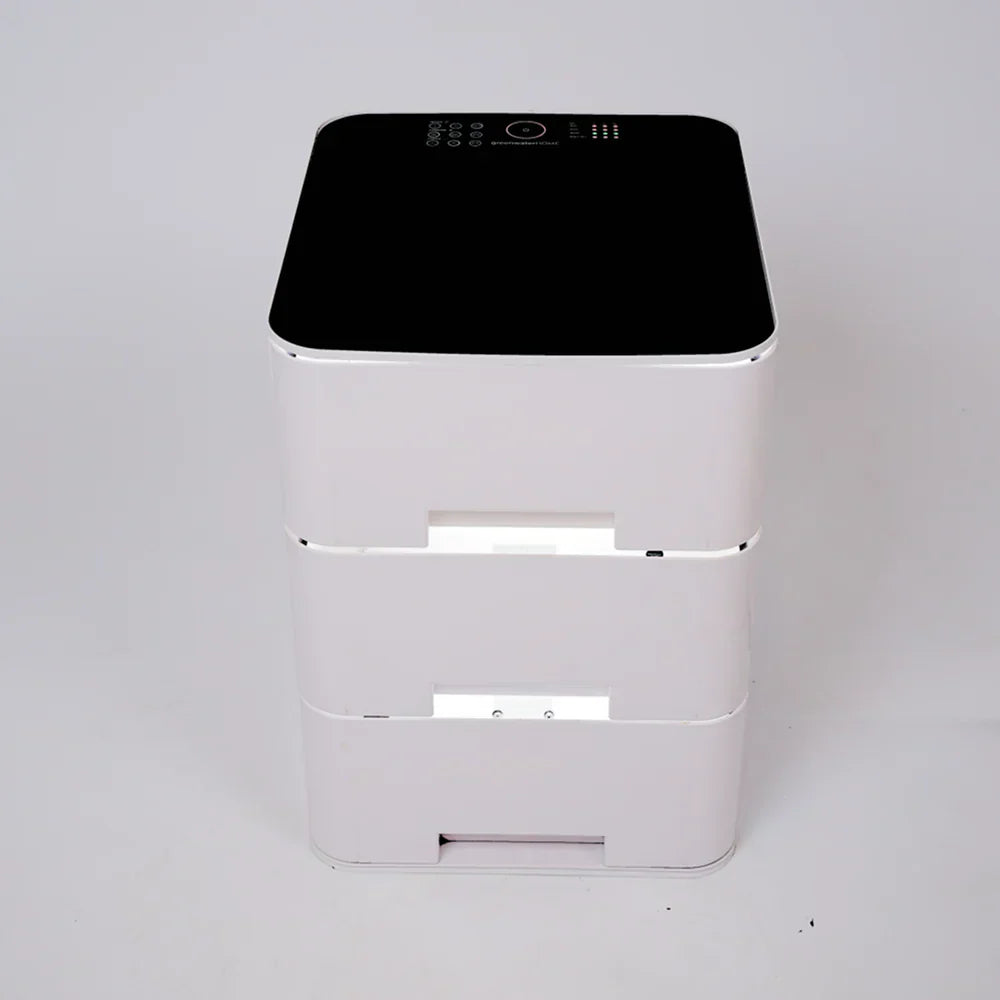
The Greenwater Air Synthesizer does not stop there.
Two Things Happening at Once
The device runs a 3-stage filtration system first. Dust, smoke, VOCs, anything particulate gets caught and cleared before anything else happens. HEPA grade. Standard stuff, done well.
Then the air hits the microalgae chamber.
This is the part no conventional purifier does. The algae take the CO2 passing through and convert it into oxygen through photosynthesis. The same process a forest runs, compressed into a device that sits on your desk. CO2 goes in. Fresh oxygen comes out.
By the time air leaves the device, it has been filtered and biologically refreshed.
Why the Second Step Matters
An air purifier that only filters is working on what is in the air. Particles, VOCs, allergens. It cleans what is there.
Photosynthesis changes what is there. CO2 out, O2 in. In a sealed room with two people, CO2 can climb from 450 ppm to over 1000 ppm in under two hours. Harvard research puts the cognitive hit at around 15 percent at 1000 ppm. At 2500 ppm it is over 50 percent.
Filtering the air does not touch this. The CO2 keeps climbing regardless of how clean the particulates are.
Why Microalgae and Not Just More Filters
Filters are passive. They catch what passes through them. They cannot produce anything.
Microalgae are alive. Single-celled, suspended in water, with light hitting them from all directions. Their photosynthetic efficiency runs roughly 10 to 50 times higher than most plants per unit of biomass. NASA has used microalgae in closed-loop life support research for decades.
Forty houseplants in a sealed room would not move your CO2 numbers. A microalgae culture in a compact column will.
What the Device Needs to Run
Three things: light, water, and the CO2 already in your room.
Built-in LEDs handle the light, tuned to the red and blue spectrum microalgae actually absorb. No sunlight required, no window placement needed.
Water goes into the bays of the machine. The algae culture sustains itself from there.
The Safety Question
The microalgae are fully contained inside the device. The same strains are in the Spirulina supplements that you can find anywhere. What comes out of the device is clean, oxygen-rich air.
Common Questions
So is this an air purifier or something else?
Both. It filters dust, smoke, and VOCs through a 3-stage HEPA system. It also generates fresh oxygen through microalgae photosynthesis. No other purifier on the market does the second part.
Do I need to keep buying replacement filters?
No. The filters are washable and reusable. Clean them when needed and put them back.
Does it need sunlight?
No. Built-in LEDs tuned to the right spectrum handle it entirely.
How often does it need maintenance?
Refill the water reservoir when it runs low, and clean the filters periodically. The algae culture maintains itself.
Does it work best in a sealed room?
Yes. Higher indoor CO2 means the algae have more to work with and photosynthesize faster. The more sealed the room, the more useful the second stage becomes.

Leave a comment
This site is protected by hCaptcha and the hCaptcha Privacy Policy and Terms of Service apply.