
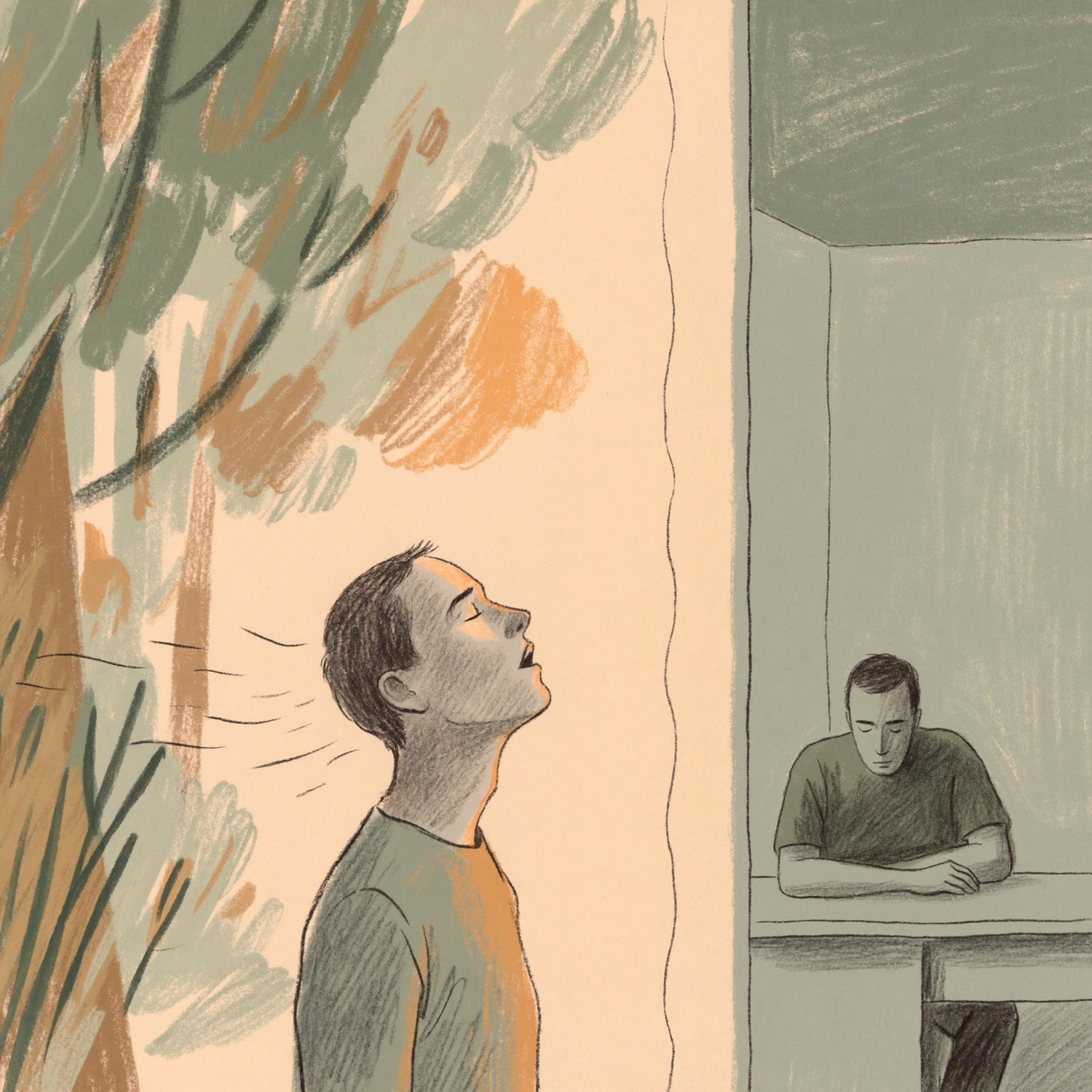
There is a specific relief that comes from stepping outside.
Not the relief of a break, or fresh movement, or the absence of screens. Something more molecular than that. You walk out of a building — any building, a hotel lobby, a mall, a long meeting — and you take one breath, and something in you exhales that had been held tight for hours without your noticing. Your shoulders drop. Your thoughts unspool a little. The world sharpens.
We have a word for this in India. We say "thoda fresh air lo." Just get some fresh air. We say it the way we say drink water, get some sleep — as if it is so obvious it barely needs saying. As if fresh air is simply there, waiting, the moment you open a door.
But what exactly is the air giving you? And why doesn't the air inside — cooled, cleaned, circulated — give you the same thing?
In Japan, they have been asking this question scientifically since the 1980s.
Shinrin-yoku — forest bathing — began as a public health initiative and became one of the most studied wellness practices in the world. Not because the Japanese discovered something mystical, but because they decided to measure something most cultures simply accepted as pleasant: the feeling of being in a forest.
What they found was more specific than anyone expected.
In a landmark study led by Dr. Qing Li at Nippon Medical School in Tokyo, twelve healthy office workers spent three days in Japanese cypress forests. They walked slowly. They breathed. They were not exercising intensely — the point was the air itself, the immersion, the particular quality of being inside that environment.
Nearly all of them showed higher natural killer cell activity afterward — a roughly 50% increase compared with before the trip. Natural killer cells are the body's front-line defence: the immune cells that detect and destroy damaged or infected cells before they can multiply. This effect lasted at least seven days after the trip, and in subsequent studies, some participants showed benefits persisting for up to 30 days. ScienceDirectCO2 Meter
A single weekend in a forest. An immune boost that lasted a month.
The question is: what in the forest was doing this?
The researchers found several things working together — the quiet, the visual texture, the reduction in stress hormones like cortisol and adrenaline. But one element kept appearing in the data: phytoncides. These are volatile organic compounds that trees release into the air — part of the forest's own immune system, a way of protecting themselves from bacteria and insects. When humans breathe them in, something unexpected happens. They trigger a measurable increase in natural killer cell activity, along with increases in other immune cells and the proteins they use to do their work. nih
The forest was not just beautiful. It was pharmacological.
But here is the part that does not make it into most conversations about forest bathing. Alongside the phytoncides, alongside the negative ions and the microclimate, the forest offers something else: air with CO₂ at approximately 400 to 420 parts per million. Clean, open, cycling outdoor air — the molecular composition that human lungs evolved alongside for hundreds of thousands of years.
The sealed AC room you have been sitting in for the last five hours? Typical indoor CO₂ concentrations in occupied spaces can reach several thousand ppm, while outdoor air ranges from approximately 380 to 500 ppm. By the time you step outside and feel that relief — that involuntary loosening — your body has been breathing air two to three times denser in CO₂ than the air it was built for. Tfb
What feels like a walk in the forest is, in part, your lungs remembering the correct ratio.
This matters more than it used to, because for most of urban India, the forest is not available on a Tuesday afternoon.
We live and work in cities where going outside means navigating heat that touches 42 degrees and air that carries its own problems. The outdoors is not always the answer. So we stay inside — which, on balance, makes sense. The sealed room is safer in many ways. Cooler. Quieter. More controllable.
Except in one specific, invisible way, it is not. The sealed room gradually replaces outdoor air with exhaled air. It trades 400 ppm of CO₂ for 1,400. It removes the cycling, the renewal, the constant exchange that outdoor air performs without anyone asking it to. The forest, which has been managing CO₂ and oxygen for three billion years, is simply not there.
And the body notices, even when the mind does not.
The ancient logic of shinrin-yoku was never really about trees. It was about a particular quality of air — living, cycling, oxygen-rich, low in CO₂ — that human beings have always needed and only recently begun to lose access to.
What if that quality of air could exist in the room where you live?
Not as a metaphor. Not as a scented candle or a plant on a shelf. But through actual photosynthesis — micro-algae, the same biology that oxygenated this planet long before the first forest existed, doing in your living room what forests do across mountainsides: drawing down CO₂, producing fresh oxygen, shifting the molecular composition of the air toward something your lungs recognise as right.
That is what greenwaterHOME was built to do. Not to replace the forest — nothing replaces the forest. But to bring the most essential thing the forest is giving you, into the room where you spend most of your life.
The relief you feel stepping outside is real. It is not imagination, it is not just the novelty of a break.
It is your body responding to better air.
You do not need to wait for the weekend to feel it.

Leave a comment
This site is protected by hCaptcha and the hCaptcha Privacy Policy and Terms of Service apply.