
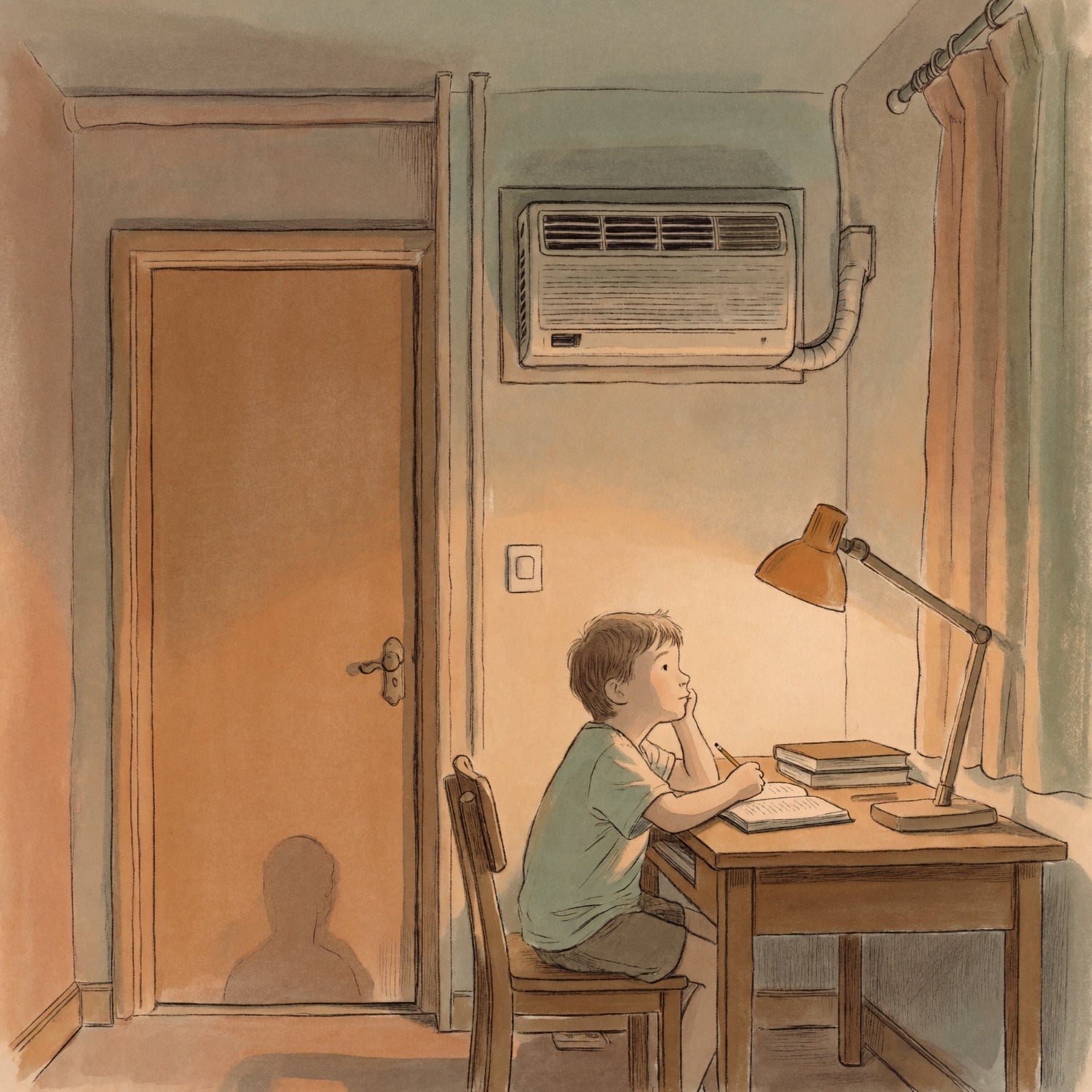
You have tried everything.
A dedicated study table. A schedule. No phone after 7pm. Breaks every forty-five minutes. A tutor on Tuesday afternoons. You have read the articles about dopamine and distraction, about how the teenage brain is not fully formed, about screen time and sleep and the importance of consistency.
And still, some evenings, you watch your child sit at that desk — in that room, door closed, AC on, books open — and produce nothing. Or something far below what you know they are capable of. And you wonder, quietly, whether you are missing something.
You are. But it is not what the parenting columns have been telling you about.
It is the air.
In 2015, researchers studying Danish schoolchildren made a finding that should have changed how we think about children's learning environments. When the outdoor air supply in classrooms was increased — meaning more fresh air was cycled in, CO₂ came down — children's correct answers improved significantly across four performance tests: addition by 6.3%, number comparison by 4.8%, grammatical reasoning by 3.2%, and reading comprehension by 7.4%. ThePrint
Nothing else changed. Same children. Same teacher. Same subject matter. Same time of day. The only variable was the air.
Lower CO₂ concentrations were associated with higher cognitive test scores, even over a low range of CO₂ exposures — and peak CO₂ exposures showed the strongest statistical evidence of associations with poorer performance. ScienceDirect
Read that again. Even at the low end of CO₂ variation — the kind of variation that happens between a slightly open window and a slightly closed one — children's test performance moved. At the high end, when CO₂ peaked, the effect was sharpest.
This is not a theoretical concern. This is measurable, in classrooms, in children, right now.
The reason it happens has to do with how a child's brain uses oxygen.
A developing brain is metabolically hungry. It consumes a disproportionate share of the body's oxygen supply — more, proportionally, than an adult brain. It is building new connections, consolidating new information, learning to hold multiple ideas at once and relate them to each other. These are cognitively expensive activities. They require clean air to do them well.
When CO₂ builds up in a sealed room, oxygen concentration does not fall dramatically — but the ratio shifts. The air becomes denser, heavier, less efficient to breathe. The brain's ability to sustain complex, effortful thinking — the exact kind of thinking that homework requires — begins to slip. Not dramatically. Quietly. In ways that look, from the outside, exactly like distraction. Exactly like laziness. Exactly like not trying hard enough.
A study of classrooms across South Delhi found that indoor air quality was measurably poorer in winter months — the months when windows stay closed, when AC or heating runs continuously, when children are most sealed inside. The research found that fresh air flow rate and occupancy level play a vital role in indoor air quality, and recommended proper utilisation of windows and increased break times to dilute accumulated CO₂. Dilute. The word implies it is already there, already building. It just needs somewhere to go. nih
In a home study room, with the door closed and the AC on, it has nowhere to go.
This is not a school problem that ends at 3pm.
After school, children come home and sit in another sealed room to do the work from the sealed room they just left. The study is usually smaller. Often it is the bedroom. The window is closed because of noise, or because of mosquitoes, or because the AC is on. One child, working for two hours, can push CO₂ in a small room past 1,200 ppm. Past 1,500, if the session runs long.
These are the levels at which research consistently shows cognitive performance declining. These are the levels at which attention wavers, at which the mind skips across the surface of a problem instead of going deep into it, at which a child who is genuinely trying finds that trying feels like moving through water.
And no one — not the child, not the parent, not the tutor — connects it to the air. Because the air is invisible. Because the room looks perfectly fine. Because we have been taught to look everywhere else.
The oldest solution to this problem is the simplest one: open the window, and the air fixes itself. The CO₂ disperses. Fresh oxygen comes in. The room breathes.
But for a growing number of Indian families, that solution is complicated. The outdoor air in most Indian cities carries its own burden — particulates, pollution, heat. Opening the window is not always a net improvement. Sealing the room was a rational response to an outdoor environment that had become hostile. The problem is that the solution to one problem created another, and the second problem is invisible.
What if the room itself could manage its own air? Not by filtering pollutants and stopping there — but by actively producing fresh oxygen and drawing down CO₂, the way a living system does. Continuously. Quietly. Without requiring a decision every time.
Imagine your child sitting at that desk in a room where the air stays closer to what outdoor air used to be — before the windows had to close, before the AC became non-negotiable. Where the concentration of CO₂ stays low not because a window is open, but because something in the room is actively breathing back.
That is what greenwaterHOME does. It does not replace the window. It restores what the window used to give.
Your child is not distracted. Your child is not lazy. Your child may simply be sitting in the wrong air.
That is a solvable problem. And knowing it is a problem is where solving it begins.



Leave a comment
This site is protected by hCaptcha and the hCaptcha Privacy Policy and Terms of Service apply.