
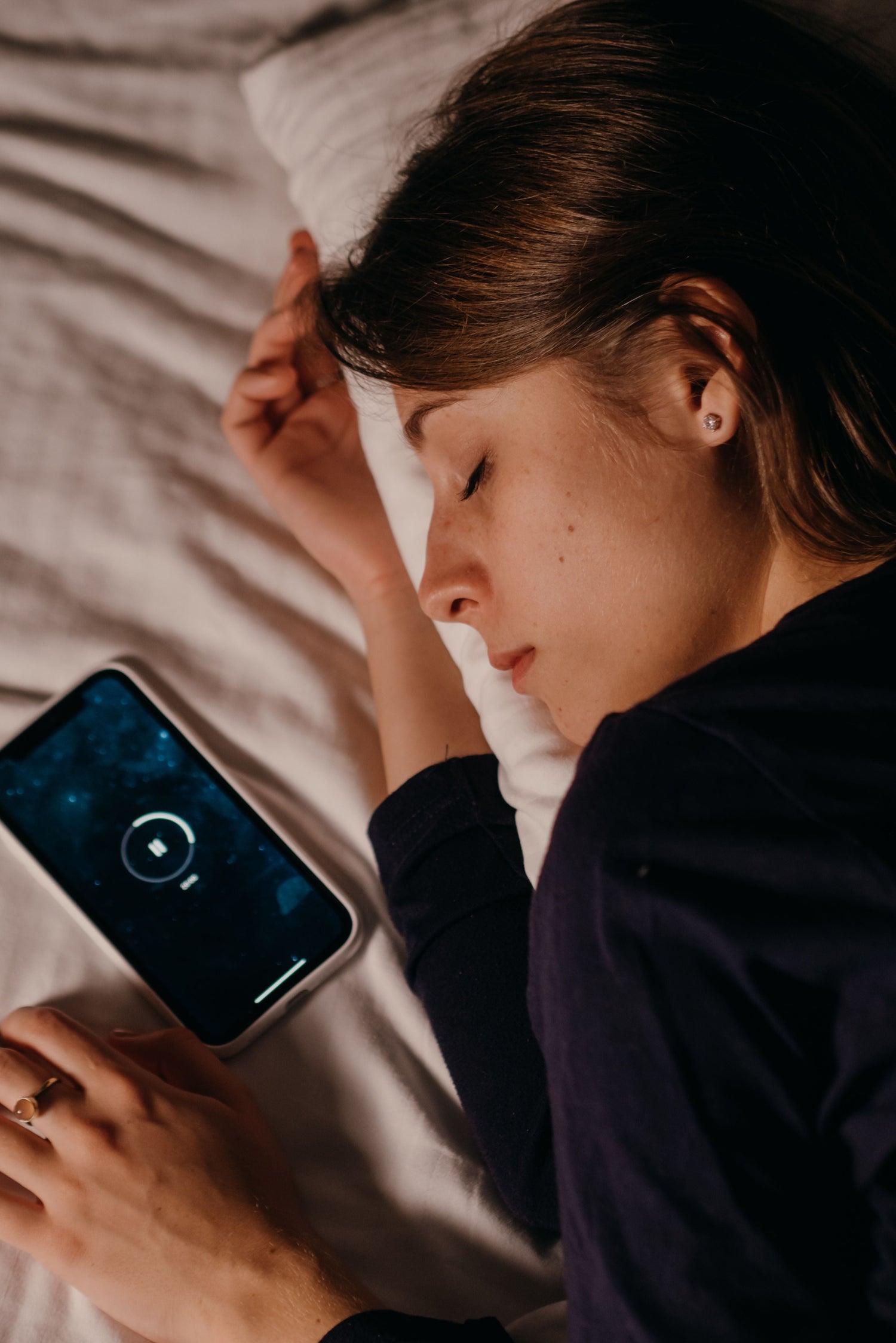
I have a friend who bought her fitness tracker because she read that SpO2 dips during sleep could be an early warning sign of something serious. She set up overnight monitoring, checked her numbers every morning. Most nights she's fine. But three or four times a month she wakes up to a reading in the low 94s and spends the next hour quietly spiraling about whether she needs a sleep study.
Nobody told her to check the room first.
SpO2, or blood oxygen saturation, is one of the more viscerally alarming metrics a wearable can surface. When it dips, people tend to jump straight to medical explanations. Sleep apnea. Respiratory issues. Altitude. These are real possibilities and worth ruling out. But there's a simpler variable sitting between you and a diagnosis that almost nobody thinks to examine: the air composition in the room where you sleep.
Here's what the research actually says, and how to think through whether your room is contributing to what you're seeing.
Your bedroom is not the same room you went to sleep in
When you close your door and windows at night, you're not sealing yourself into a static environment. You're sealing yourself into a room that will gradually change over the next eight hours.
A single adult sleeping in a standard sized bedroom generates enough CO2 through breathing to push concentrations from the outdoor baseline of around 400 ppm to somewhere between 1,500 and 2,500 ppm by morning. Two people in the same room can push it higher. The room gets progressively more CO2-rich and progressively more oxygen-depleted as the night goes on.
By the time you're in your deepest sleep in the early hours of the morning, you're breathing air that's materially different from what you started with. Your wearable is capturing your body's response to that shift. Most people assume the room is constant and look for the explanation elsewhere.
How CO2 and oxygen availability interact with SpO2
SpO2 measures the percentage of hemoglobin in your blood that's carrying oxygen. A healthy resting reading is typically 95 to 100 percent. Anything below 95 starts to raise questions.
In a sealed room with elevated CO2, two things are happening simultaneously. First, the available oxygen concentration is slightly lower than in a well-ventilated space. Second, and more significantly, elevated CO2 in the blood affects how efficiently hemoglobin releases oxygen to your tissues, a relationship described by the Bohr effect. Your body compensates by increasing respiratory rate, but in deep sleep your breathing is slower and shallower, which limits that compensation.
The result is that mild but real dips in SpO2 are more likely to occur in the second half of the night, when CO2 has had hours to accumulate and you're in your deepest, slowest-breathing sleep stages. This maps almost exactly to when most wearables record their lowest overnight SpO2 readings.
The altitude comparison is more useful than it sounds
If you've ever slept at high altitude, you know what it feels like: fragmented sleep, vivid or strange dreams, waking up feeling like you didn't rest at all. What's happening physiologically is that reduced oxygen partial pressure is affecting your sleep architecture and your SpO2.
A sealed urban bedroom at 2,000 to 2,500 ppm CO2 is not the same as sleeping at high altitude. The oxygen depletion is far milder. But the mechanism has overlap: your body is working slightly harder to maintain adequate oxygenation, and that mild physiological stress shows up in your recovery metrics.
People who live at altitude buy oxygen concentrators. People who sleep in sealed urban bedrooms buy more supplements and wonder why their scores aren't improving.
The difference between a room problem and a health problem
This matters because the interventions are completely different, and chasing the wrong one wastes time and creates unnecessary anxiety.
Sleep apnea causes SpO2 drops through airway obstruction. The dips tend to be more severe, more frequent, and correlated with snoring or gasping events. A room CO2 problem causes milder, more gradual dips that tend to be worse in the second half of the night and correlate with how sealed the room was.
A few things worth looking at if you're seeing unexplained SpO2 dips: whether the dips are worse in winter when windows stay closed, whether they're better on nights you slept with a window cracked, whether two people sleeping in the room produce worse readings than one. These are room variables, not body variables.
If the pattern tracks with ventilation rather than with sleep position, snoring, or alcohol, the room is the more likely explanation.
Filtration doesn't solve this
This is the part that tends to catch people off guard. A HEPA air purifier running in the bedroom will reduce particulate matter. It will not address CO2. Filtration is a one-directional process: it removes things from the air that shouldn't be there. It has no mechanism for drawing down CO2 or generating fresh oxygen.
So if you've added an air purifier to your bedroom in response to poor overnight metrics and haven't seen the improvement you expected, this is likely why. You've addressed one dimension of air quality, not the one that's most relevant to overnight oxygenation.
The variable that matters for SpO2 and CO2-driven sleep disruption is active gas exchange: something that pulls CO2 out and puts O2 back in. That's a biological process, not a mechanical filtration one.
What active oxygen generation actually does for a bedroom
The Greenwater Air Synthesizer runs a micro algae photosynthesis chamber continuously. Algae takes in CO2 and produces oxygen through the same mechanism plants use, but at a density and scale that makes a measurable difference in a closed room overnight. Paired with a 3-stage washable HEPA filtration system, it's addressing both the particulate problem and the gas composition problem simultaneously.
The filters are washable and reusable. The algae chamber doesn't switch off when the fan slows down. It's working through the night, during the exact window when CO2 is peaking and your SpO2 is most vulnerable.
Before assuming a low SpO2 reading means something is wrong with you, it's worth spending a few nights finding out whether something is wrong with the room.

Leave a comment
This site is protected by hCaptcha and the hCaptcha Privacy Policy and Terms of Service apply.