
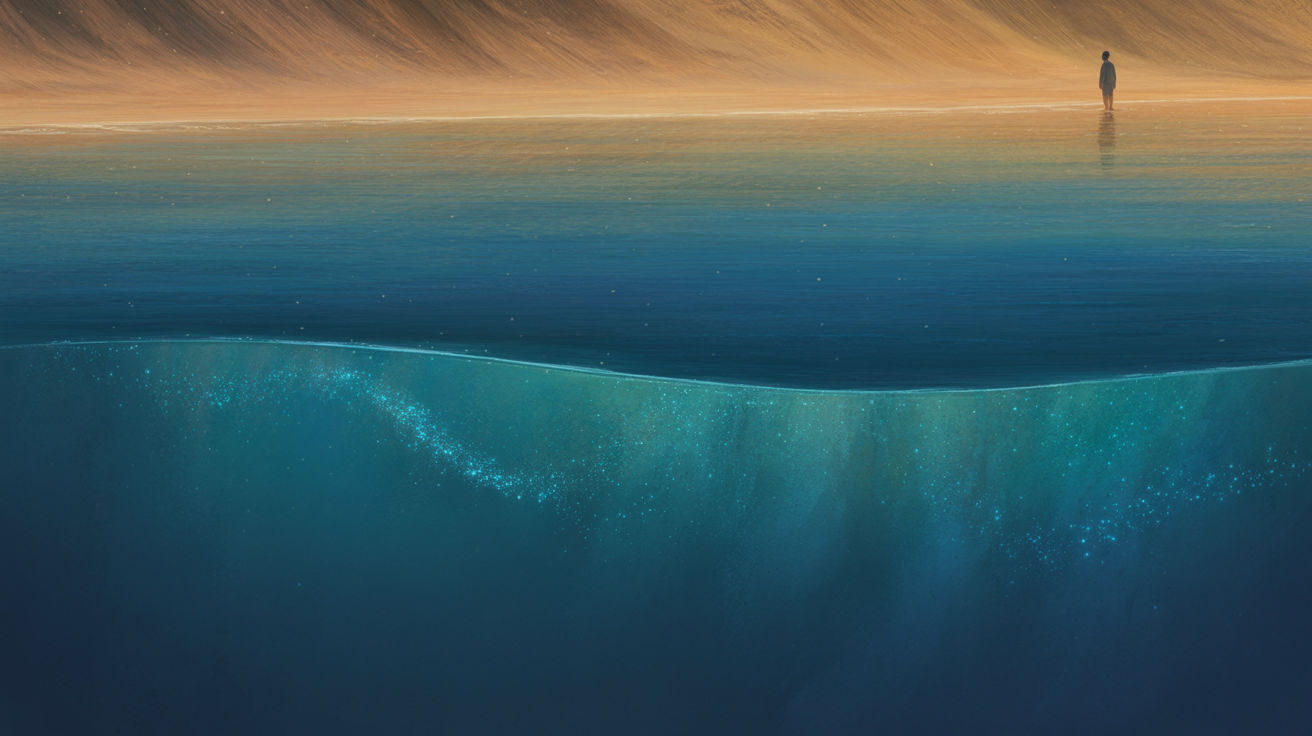
Take a breath.
Not a conscious, deliberate one. Just the next one that comes. The one happening right now, as you read this, without you asking it to.
Half of the oxygen in that breath — roughly, give or take, depending on the season and the science — did not come from a tree. It did not come from a forest, or a park, or the plant on your windowsill. It came from the ocean. Specifically, from organisms so small that twenty thousand of them fit in a single drop of seawater. Organisms you have never seen. Organisms most people have never thought about, even once, in their entire lives.
They are called phytoplankton. And today — World Oceans Day — feels like the right moment to finally introduce them properly.
Here is what they do, and why it matters.
Phytoplankton are floating, drifting, plant-like organisms that harness the energy of the sun, mix it with carbon dioxide drawn from the atmosphere, and turn it into carbohydrates and oxygen. Scientists estimate that at least 50% of the oxygen in our atmosphere has been produced by phytoplankton.
They are algae. Single-celled, microscopic, ancient beyond reckoning. They have been doing this — photosynthesising, producing oxygen, drawing down carbon — for billions of years. Long before the first tree. Long before the first animal drew breath. The oxygen that made complex life on this planet possible was not produced by forests. It was produced by algae in the ocean.
One species alone — Prochlorococcus, a bacterium so small that 20,000 of them fit in a single drop of seawater — produces 5 to 10% of the oxygen in our entire biosphere. More than all the tropical rainforests on Earth combined. If you want to understand just how extraordinary micro-algae are as carbon and oxygen machines, the scale of it is genuinely hard to believe.
You have been breathing the work of these invisible organisms your entire life. Every life on land has. The ocean has been the planet's lungs since before lungs existed.
This year, the United Nations chose Reimagine as the theme for World Oceans Day. The invitation is to see the ocean differently — not as something distant and separate, but as something woven into daily life. The air we breathe, the food we eat, the climate balance that makes our existence possible.
It is a generous framing. But the science makes it more than poetic.
The ocean is not a metaphor for the air we breathe. It is the literal source of a significant portion of the air we breathe. Every day. Right now. Through the quiet, continuous labour of organisms that have no voice, no visibility, and no lobby.
And here is the part that should give us pause.
A 2025 study published in Science Advances found that ocean chlorophyll concentration — the measure scientists use to track phytoplankton biomass — declined significantly across more than 32% of low- to mid-latitude ocean area between 2001 and 2023. The ocean, in other words, is losing some of its green. The organisms that produce half our oxygen are, in parts of the world, in retreat. Warming seas, changing nutrient flows, disrupted mixing patterns — all of it adding up to quieter, less productive water.
The planet's oldest oxygen system is under pressure.
There is something else worth sitting with today.
The same biology — algae, photosynthesis, CO₂ in, oxygen out — that has been oxygenating this planet for billions of years is the biology that greenwaterHOME brings into a room.
Not as a symbol. Not as a gesture toward nature. As a functioning, living system.
We have written before about why forest air feels the way it does — the particular quality of air that human lungs have always recognised as right. The ocean is the deeper version of that same story. Forests borrowed the trick from algae. Algae have been running the programme since the beginning.
What greenwaterHOME does is take that same process and make it work at the scale of a room. If you have ever been curious about exactly how much CO₂ is accumulating in your sealed AC room right now — while you work, while you sleep, while your child studies — the numbers tend to be more confronting than most people expect.
The ocean cannot fix your indoor air. It is busy enough fixing the planet's. But the organism it has always used to do that work can work indoors too. Has always been able to. We just never thought to ask it to.
The relief you feel stepping outside — the particular quality that forests have always given us without our understanding why — is real. It is not imagination. It is your body responding to better air.
The ocean has been breathing for us since before we existed.
Maybe it is time we learned to breathe a little more for ourselves.
Learn more about the greenwaterHOME Air Synthesizer at greenwaterscientific.com


Leave a comment
This site is protected by hCaptcha and the hCaptcha Privacy Policy and Terms of Service apply.