
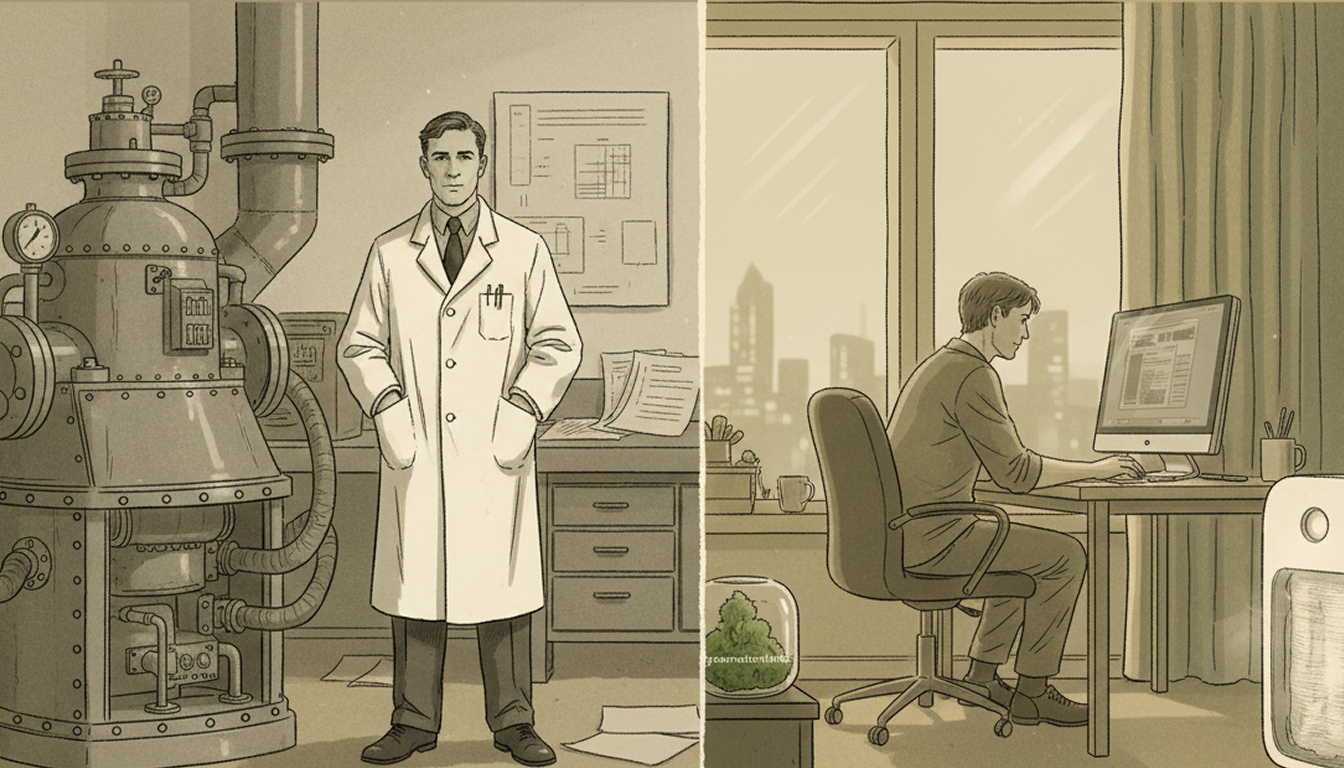
There is a piece of technology sitting in millions of Indian homes right now that was invented to protect scientists building the atomic bomb.
You probably own one. Or have considered buying one. It sits in the corner of your bedroom or living room, hums quietly, and displays a colour that tells you the air is clean. It costs anywhere from ₹5,000 to ₹80,000. It is, in most cases, running technology that is over eighty years old.
It is your air purifier. And it is doing less than you think.
In August 1942, the United States government launched the Manhattan Project — the classified programme that would produce the world's first atomic bomb. More than 90,000 people worked on it across secret facilities. And very quickly, the scientists running it faced a problem nobody had solved before: the development and manufacturing of nuclear material released radioactive particles into the air. Microscopic, lethal, invisible. The kind of thing that couldn't be seen, but would kill you slowly if you breathed it long enough.
The US Army Chemical Corps brought in Nobel Laureate Irving Langmuir to solve it. He identified that particles of 0.3 microns in diameter were the most dangerous — small enough to evade the body's natural defences, large enough to carry radioactive contamination. The solution they built was a dense mat of fibres that forced air through a tortuous path, trapping anything solid above that threshold.
They called it a High-Efficiency Particulate Air filter. HEPA. A wartime secret, classified for years. When the war ended and the technology was declassified, it found its way into homes. The first residential HEPA air purifier was sold in 1963. And in the six decades since, the air purifier industry has done something remarkable: it has made the device sleeker, quieter, smarter, and Wi-Fi connected — without ever changing what it fundamentally does.
A fan. A fibre mat. Solid particles trapped. Air pushed through and returned to the room.
Bunker technology, dressed up for the living room.
Now here is the part the industry has never had to answer for — because nobody has been asking the right question.
Air purifiers do not remove CO₂. HEPA filters, activated carbon, and UV-C are all designed for particulate matter and VOCs. They are not designed for carbon dioxide — which is too small and too abundant for any standard filtration mechanism to address. CO₂ is a gas. It flows straight through the fibre mat that stops dust and pollen. It passes through the activated carbon that catches odours. It is, from the perspective of every air purifier ever made, completely invisible. nih
And CO₂ is exactly what is making you feel the way you feel in a sealed room.
Every breath you exhale adds CO₂ to the air around you. In a room with good ventilation, it disperses. In a sealed, air-conditioned room — the kind that defines modern urban Indian living — it accumulates. By mid-morning in an occupied office, CO₂ levels routinely cross 1,000 ppm. By afternoon, 1,400. These are the levels at which research consistently shows cognitive performance declining — the brain fog, the fatigue, the headaches that arrive around 3pm and that we have spent decades blaming on lunch, on screens, on ourselves. If you want to know exactly how much CO₂ might be building up in your room right now, our Air Calculator shows you in real time what one person, two people, or a full room does to air quality over the course of a day.
Your air purifier cannot touch any of it. It is completely blind to the gas you exhale.
The air purifier was never designed for the problem you actually have.
It was designed for radioactive particles in a nuclear weapons facility. It was an extraordinary solution to an extraordinary wartime problem. But the problem of a sealed home filling with CO₂ while its occupants slowly lose their afternoon — that was never the brief. That problem didn't exist in 1942, because in 1942, nobody lived and worked in hermetically sealed, air-conditioned rooms for twelve hours a day.
We do now. And we are still using 1940s technology to solve it.
The honest version of what a HEPA air purifier does is this: it removes solid particles from the air. Dust. Pollen. Pet dander. PM2.5. It does this well. It is genuinely useful for the problem it was built to solve. But it recirculates the same air in the room, over and over, without changing its molecular composition. The CO₂ goes nowhere. The oxygen-to-CO₂ ratio goes nowhere. The room continues to fill with exhaled air, and the purifier continues to clean that air of dust while leaving its most consequential problem entirely intact.
Cleaner dust. Same suffocation.
The oldest solution to CO₂ in any enclosed space is photosynthesis.
Plants, algae, and phytoplankton have been taking CO₂ from the air and returning oxygen for billions of years. It is, as we have written before, the same biology the ocean uses to produce half the planet's oxygen — and the same quality of air that forest environments have always offered to anyone who steps outside a sealed room long enough to notice the difference.
The question greenwaterHOME was built to answer is: what if you didn't have to go outside?
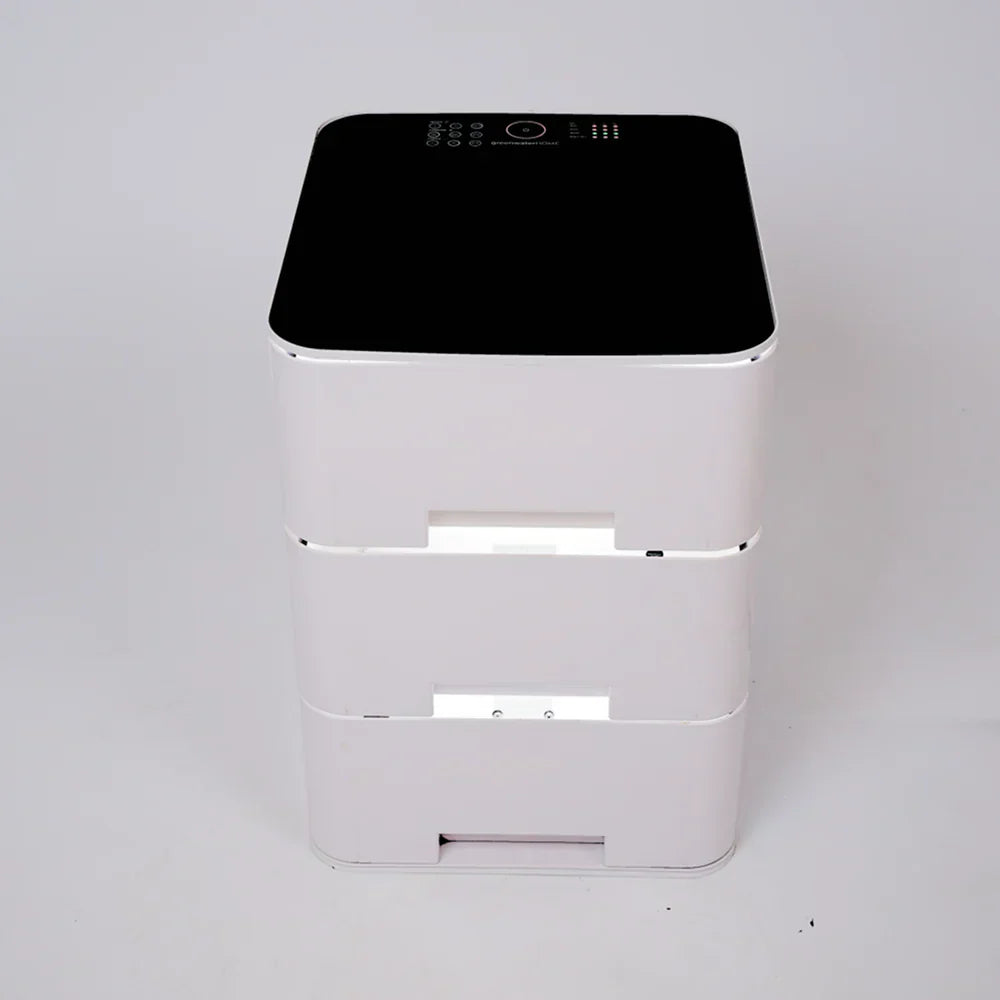
Micro-algae are the most efficient photosynthesising organisms on earth — exponentially more productive at CO₂ absorption than plants or trees, working continuously wherever there is light. greenwaterHOME uses a living culture of micro-algae to do indoors what the HEPA filter was never designed to do: change the molecular composition of the air. Actively absorbing CO₂. Actively producing fresh oxygen. Not filtering the same air in a loop — synthesising it. Shifting the ratio back toward what your lungs were built for.
It is not an air purifier. It is an Air Synthesizer. The category difference is not marketing. It is the difference between a device that was built for a nuclear bunker in 1942 and one that was built for a sealed home in 2026.
The HEPA filter was one of the great engineering achievements of the twentieth century. It protected scientists building weapons that changed history. It has saved lives in hospitals, clean rooms, and nuclear facilities around the world. It deserves its place in the story of human ingenuity.
It just shouldn't be the last word in indoor air quality.
Eighty years is a long time to go without asking what we're still missing.


Leave a comment
This site is protected by hCaptcha and the hCaptcha Privacy Policy and Terms of Service apply.